
GCSE Maths
GCSE Maths tuition built around the gaps costing marks.
One-to-one support for Foundation and Higher tier, built around what your child actually needs — whether that’s rebuilding earlier topics, gaining confidence with problem-solving or turning knowledge into marks under exam conditions.
What we support
Support across the full GCSE Maths course.
Full GCSE Maths content
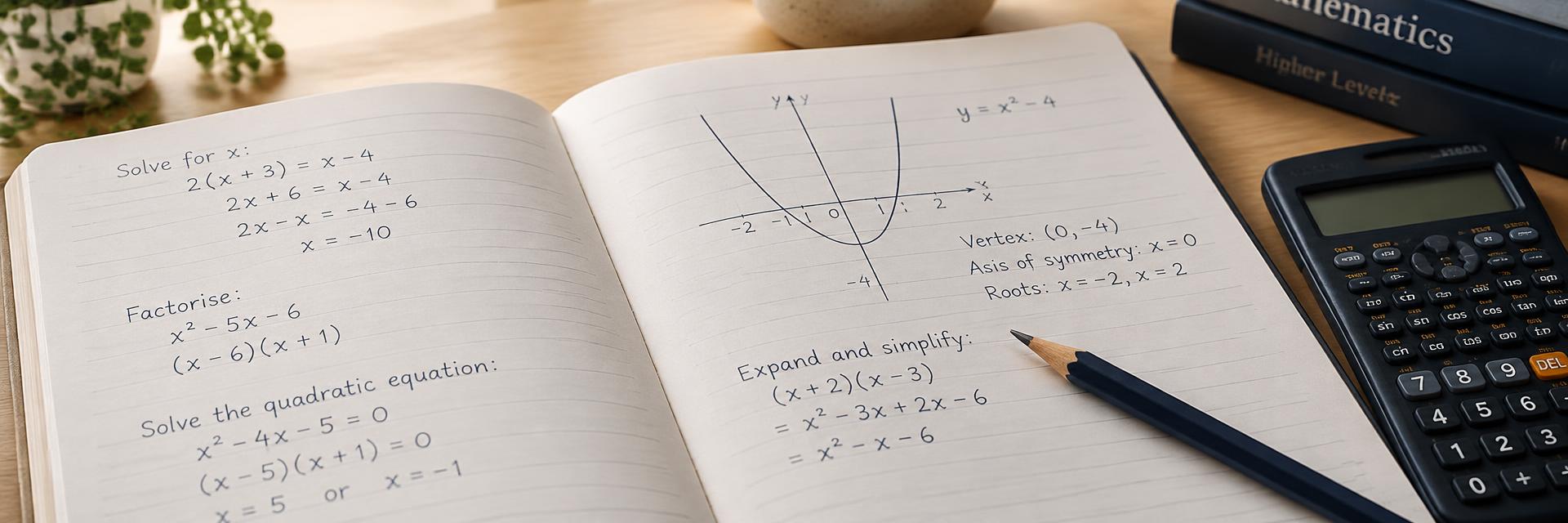
We cover the full Foundation and Higher tier course, rebuilding topics properly where needed. If something hasn’t fully clicked at school, lessons can slow it down, explain it differently and practise it until it feels secure.
Some of the most common problem topics we cover include:
- Algebra
- Fractions
- Ratio
- Percentages
- Geometry
- Probability
- Equations
- Graphs
- + more
Gaps and confidence
Maths builds on itself, so an earlier gap can quickly knock a student’s confidence when newer topics start to feel harder. One-to-one tuition gives them the space to slow things down, rebuild those foundations properly and practise without feeling rushed, until the topic feels much more manageable.
From understanding to application
Once the theory is secure, students practise applying it in different forms — from straightforward examples to multi-step questions where they have to decide which method to use.
Where marks get lost
Knowing the method isn’t always enough.
A student can understand a topic perfectly in a lesson and still lose marks when it appears differently in an exam. That gap between knowing the maths and using it under pressure is where one-to-one tuition becomes particularly useful.
The topic isn’t obvious
Questions don’t always announce which method to use. We teach students to spot the clues in unfamiliar questions and connect them back to methods they already know.
The working isn’t clear
Getting the final answer wrong doesn’t always mean getting zero marks. Tutors build the habit of showing a clear method so students can pick up the marks their understanding deserves.
Small mistakes compound
Sign errors, calculator input, units and missed steps can turn a correct approach into a lost question. Lessons slow those habits down first, then build speed once the method is secure.
In lessons
What GCSE Maths lessons focus on.
- 01
Build the understanding
We first make sure the underlying topic genuinely makes sense. That might mean reteaching part of the course, using a different explanation or going back to an earlier idea that has never fully settled.
- 02
Practise until it feels secure
Once the method is understood, students work through progressively harder examples so the process becomes familiar and reliable rather than something they can only do with help.
- 03
Apply it to exam-style questions
When the content is secure, we move into unfamiliar and multi-step questions so students learn to recognise which ideas to use and how to combine them.
- 04
Turn it into marks
Past-paper work then sharpens the final layer: showing working clearly, checking answers, managing time and understanding what the mark scheme rewards.
Why 1-to-1 works
We can go back before we move forward.
In a classroom, the course has to keep moving. One-to-one tuition gives us the freedom to stop when something isn’t secure, trace the problem back and fix the earlier idea that’s causing it.
Sometimes that means revisiting something from Year 8 or Year 9. Sometimes it means spending three lessons on algebra before returning to the current topic. The lesson follows the student rather than a fixed timetable. As those gaps start to close, students can build confidence and feel more comfortable attempting questions they would previously have avoided.
“My daughter has found her Maths sessions extremely helpful whilst studying for her GCSEs. Her tutor has really built her confidence. Her grade has improved by 3 levels in her mocks.”
Carey
Trustpilot review
GCSE Maths FAQ
Common questions about GCSE Maths tuition.
Often supported alongside GCSE Maths
Start Your Enquiry
Fill In Our Form, Book A Call & Let’s Get Started.
Tell us a little about your child, and we’ll follow up by email to arrange your consultation call and talk through the next steps.